Gutter Drainage for Pool Cages: What Dunnellon Homeowners Need to Know
@homeexteriorguide051
Pool cages solve a lot of Florida problems. They cut down on bugs, keep leaves out of the water, and make the whole backyard feel more usable for more of the year. But they also change how rain moves across your property. That is where many drainage headaches begin.
In Dunnellon, heavy summer storms can dump a lot of water fast. Add high humidity, blowing debris, and long wet stretches, and even a good-looking gutter system can start failing in ways that are easy to miss at first. Water jumps a gutter edge. A downspout empties too close to the deck. Mulch washes into the screen enclosure. The soil near a corner of the lanai stays soggy. By the time a homeowner notices the pattern, the problem has usually been building for a while.
The biggest mistake I see is treating gutters as a roof-only feature. Around a pool cage, drainage is part roof management, part yard grading, and part outdoor living design. It has to protect the house, the landscaping, and the area around the enclosure where people actually walk and gather.
Why pool cage drainage needs a different kind of attention
A standard roofline already collects a surprising amount of rain. Once that water reaches the eaves, it has to go somewhere. If the gutters are undersized, clogged, poorly pitched, or simply dumping in the wrong place, the trouble shows up quickly in Florida. Water can pool near the foundation, create pest issues, and erode planting beds or lawn areas. Florida landscape guidance consistently pushes the same principle: keep runoff on site when possible and direct it into areas that can absorb it, like turf or planted beds, rather than letting it concentrate where it causes damage.
That advice matters even more around a screen enclosure. Pool decks, pavers, and adjacent hardscape do not absorb water the way lawn does. If a downspout discharges toward the cage entrance, the splashback and runoff can turn a clean deck into a slippery mess. If it drains beside the enclosure wall, you may not notice the overflow until soil starts washing out or debris starts collecting where the screen meets the slab.
There is also a practical issue that homeowners notice before anything else: comfort. Nobody wants water pouring off a roof edge near the seating area, the grill, or the gate to the pool. Good gutter drainage for pool cages is not just about protection. It is about making the space usable after one of those typical Florida downpours.
The water has to end somewhere
A gutter system does not solve drainage by itself. It only collects and redirects. The real question is where that water lands after it leaves the downspout.
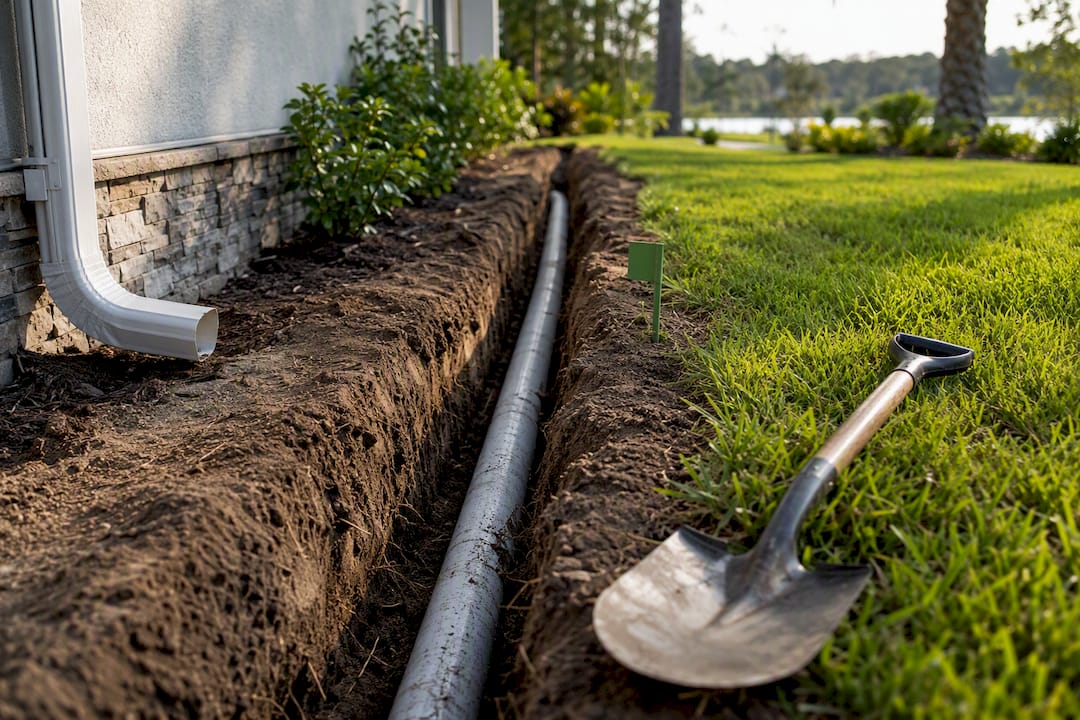
Florida-friendly landscape guidance recommends sending downspouts to lawn or planted areas that can absorb runoff. That simple idea gets overlooked constantly. Homeowners focus on the gutter profile, the color, or whether the run should be seamless, and skip the harder conversation about discharge points. Around a pool cage, discharge planning is often the difference between a system that works and one that just moves the problem ten feet away.
If your downspouts empty into turf, a planting bed, or another pervious area, you are working with the site instead of against it. If they empty onto a deck edge, a bare patch of soil, or the narrow strip between the pool enclosure and the house, the water tends to concentrate too quickly. In sandy Florida soils, runoff can move fast. That can sound harmless, but fast-moving water still scours mulch, exposes roots, and leaves behind channels and muddy washouts.
For pool-adjacent properties, this is especially important because outdoor living areas magnify the nuisance. Overflow that would be merely annoying beside a side yard becomes a constant problem if it crosses the path to the pool or splashes onto the enclosure frame.
What goes wrong around pool cages
A lot of drainage problems look small at first. A homeowner may only notice a little staining on the gutter face, a strip of washed-out sand near the cage slab, or a wet patch that lingers after the rest of the yard dries out. Those signs matter.
One common issue is simple overflow caused by debris. In Florida, leaf litter and storm debris build up quickly, and UF/IFAS guidance is clear that gutters and downspouts need routine maintenance. When water cannot move through the trough or downspout, it spills over the front edge. If that edge faces the pool deck or screen wall, the result is repeated splash and erosion in exactly the places you least want it.
Another problem is poor downspout placement. A downspout that terminates too close to the house can contribute to pooling near the foundation and pest issues. One that empties beside a cage corner can undercut the surrounding soil. One that discharges across a walking route can leave slippery algae-prone dampness in a shaded area.
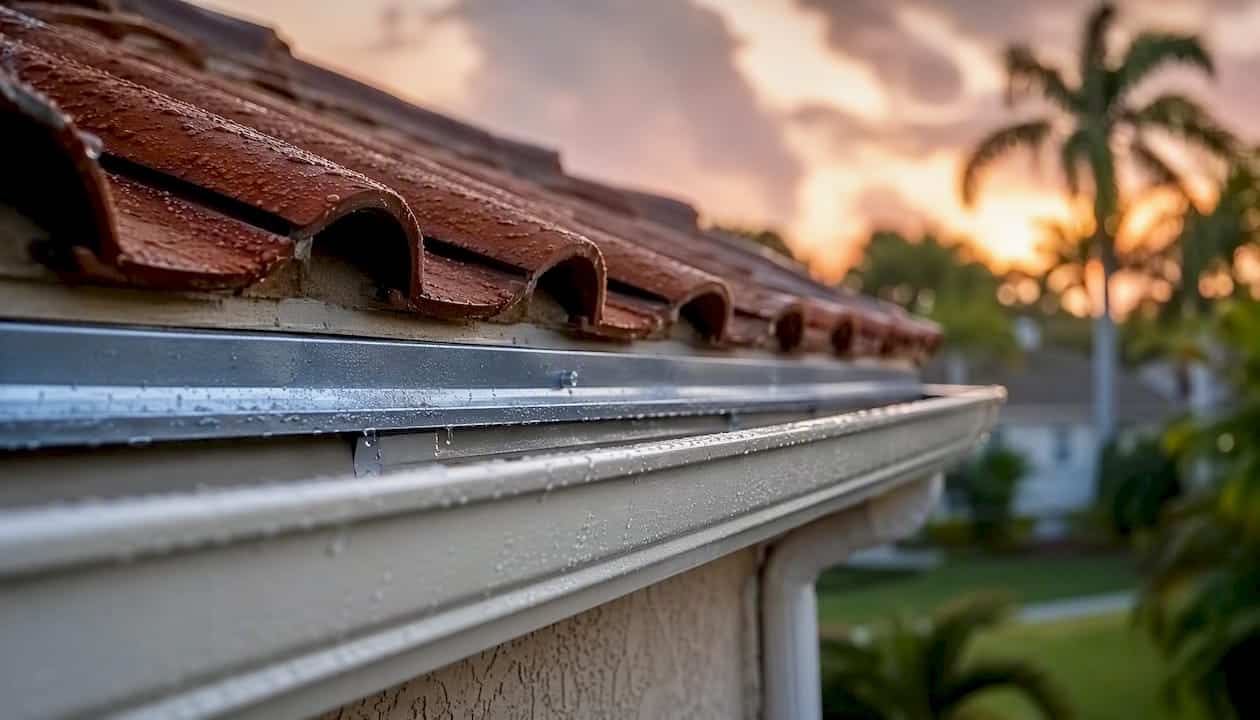
Then there is the issue of runoff concentration. A roof gathers water from a large surface and funnels it into a few spots. That concentrated flow is manageable if those spots are chosen well. It becomes destructive if they are not. Around pool cages, homeowners often have less planting area to work with because decks and enclosures take up so much of the rear yard. That means every discharge point matters more.
Dunnellon conditions make small flaws show up faster
Even without getting into exact local rainfall totals, anyone who lives in this part of Florida knows the rhythm. Sudden summer thunderstorms, long humid stretches, tropical weather, and debris blown into gutters during windy afternoons. Systems do not fail only during major storms. They often show their weaknesses during regular wet-season weather.
That is why a gutter layout that seems fine in the dry months may reveal trouble later. Water that drips for thirty minutes during a mild shower may sheet over the edge during a stronger storm. A partially clogged downspout may still move enough water in spring, then back up badly once oak leaves, pine needles, or roof grit build up.
This is where experience matters. Good drainage planning is not just about handling average conditions. It is about reducing the damage when weather is at its most demanding, because that is when the pool area gets tested.
The gutter itself matters, but not for the reasons most people think
Homeowners often start with product questions. Should they look at larger gutters? Are seamless gutters Williston FL companies advertise worth it? Do gutter guards Mount Dora FL contractors promote really cut down on maintenance? Those are fair questions, but the answer depends less on marketing language and more on whether the whole drainage path makes sense.
Seamless systems can reduce leak points at joints, which is useful, but they still need proper discharge planning and upkeep. Gutter guards may reduce some debris accumulation, https://exteriornotes775.unionquill.com/posts/do-gutter-guards-help-with-pine-needles-in-weirsdale-a-realistic-homeowner-guide but they do not eliminate the need for inspection and cleaning, especially in a climate where wind-driven litter can settle in awkward places. A stylish gutter color does not compensate for poor water routing.
That is true whether the home has shingles or a metal roof. Homeowners searching for gutters for metal roofs Florida properties often focus on attachment details and appearance. Those are relevant topics, but for pool cage drainage the larger concern remains the same: where does the water go after collection, and how does that path affect the outdoor area?
The same goes for gutter colors for Florida homes. Color matters for curb appeal, and in HOA neighborhoods appearance reviews can come into play for exterior components. Florida law gives associations authority over appearance standards, but those standards have to comply with the building code and cannot be used to deny conforming installations. That means homeowners should think about aesthetics, yes, but not at the expense of function. Matching the fascia is nice. Keeping runoff away from the pool entry is more important.
Cost questions usually come down to complexity
When people ask about gutter installation cost factors Florida contractors consider, they are often trying to compare apples to oranges. Price is shaped by roof layout, number of corners, length of runs, access, discharge planning, and the amount of detail work needed to move water into absorbent areas rather than dumping it wherever is easiest.
Pool cages can increase that complexity. They limit ladder access, complicate where downspouts can be placed, and reduce the number of obvious landing spots for runoff. Sometimes the least expensive-looking installation on day one becomes the costly one later because it creates washout, standing water, or repetitive cleanup around the lanai.
I would rather see a homeowner ask, “Where will this water discharge in a summer storm?” than “What is the cheapest profile available?” That first question usually leads to a better system.
Cleaning is not optional in Florida
There is a reason gutter cleaning Dunnellon FL is a common search phrase. In this climate, neglect catches up fast. The combination of organic debris and frequent rain turns a minor maintenance task into a serious drainage problem if it gets postponed too long.
Some homeowners are comfortable doing the work themselves. Others would rather schedule service. The better question is not whether cleaning is inconvenient. It is whether the system is being checked often enough to catch clogs, loose sections, or early signs of overflow before they affect the pool area.
Here is the practical split on DIY gutter cleaning or hire a pro:
- If the gutters are easy to access and you can inspect them safely, some routine cleaning may be manageable.
- If the pool cage, roof height, or layout creates awkward ladder angles, professional help is often the smarter call.
- If you are already seeing overflow, recurring clogs, or erosion near the enclosure, inspection matters as much as debris removal.
- If downspouts discharge near the house or the lanai, check that water is still reaching a pervious area and not backing up at the outlet.
- If you are unsure whether the problem is cleaning, slope, or placement, bring in someone who can diagnose the whole path of the water.
That last point is where many homeowners save time and frustration. A gutter can be spotless and still perform poorly if the drainage plan was flawed from the beginning.
A few gutter myths that trip up Florida homeowners
Some of the most persistent gutter myths Florida homeowners believe come from oversimplifying what gutters do. One myth is that gutters are only there to stop drips at the roof edge. In reality, they are part of runoff control. They help protect foundations, planting beds, and walkways by directing water where it can soak in safely.
Another myth is that once guards are installed, the system becomes maintenance-free. Florida debris and storm patterns do not work that way. Anything that handles roof runoff still needs periodic checks.
A third myth is that if there is no visible leak in the gutter itself, the system is fine. Around a pool cage, drainage failure often shows up on the ground first. Washed mulch, puddling near doors, persistent dampness, or splash marks on enclosure framing can all point back to roof runoff.
The final myth I hear often is that all downspout discharge is basically the same as long as it is away from the roofline. It is not. Sending water toward turf or planted areas is a very different outcome from dumping it onto hardscape or beside a slab edge with nowhere to absorb.
What a sensible inspection looks like
You do not need a dramatic failure to justify a closer look. A calm visual inspection after an ordinary rain can tell you a lot. Watch how water leaves the roofline, whether it stays inside the gutter, and where it ends up after it exits the downspout. Around the pool cage, look for repeated splash zones, debris trails, fresh erosion, or damp soil that stays dark longer than nearby areas.
If you are evaluating an existing system, keep these five questions in mind:
- Does water stay in the gutter during a normal storm, or does it spill over edges or seams?
- Do downspouts direct runoff away from the foundation and toward lawn or planted areas that can absorb it?
- Is any discharge creating mess or slick surfaces near the pool deck, gate, or seating area?
- Are there signs of debris buildup, slow drainage, or recurrent overflow after windy weather?
- Is soil washing out near the enclosure, planting beds, or hardscape joints?
These are simple observations, but they are usually more useful than staring at product brochures.
Repairs should match the actual problem
Homeowners sometimes jump straight to replacement when they really need correction. Other times they keep patching a layout issue that will never behave properly until the discharge is changed. That is why gutter repair Hawthorne FL style service calls, or any repair call in a similar Florida setting, work best when the contractor looks beyond the damaged section and follows the full runoff path.
A leaking seam is one problem. A downspout emptying into a non-absorbing corner beside the pool cage is another. A sagging run may need adjustment. A persistent overflow may point to maintenance, sizing, or outlet restrictions. You want a fix that matches the cause.
For homeowners planning broader exterior work, this is also a good time to think about drainage and landscape together. Florida-friendly guidance encourages keeping runoff on site, which means there may be opportunities to direct water into lawn, beds, or other pervious zones in a way that reduces mess while supporting the yard.
The best systems respect both the house and the backyard
A well-planned gutter system does not call attention to itself. You notice that the pool deck stays cleaner. The gate area dries out faster. Mulch stays where it belongs. Water does not collect near the house, and the planting beds are not carved up after every hard rain.
That result comes from judgment more than gimmicks. The best setup for one home may not fit the next one, especially when one property has broad lawn around the lanai and another has more hardscape with limited absorbent area. The common thread is that runoff is collected, directed away from the foundation, and discharged where the site can handle it.
That may sound basic, but it is exactly the part people skip when they focus only on materials or cosmetic choices.
A year-round habit beats emergency fixes
If there is one mindset that serves Dunnellon homeowners well, it is consistency. Gutters in Florida are not a once-a-year concern. They are part of year-round exterior upkeep. A sensible year-round gutter checklist Florida homeowners can actually follow is less about perfect timing and more about paying attention before and during the wet season.
Look at the system after windy days. Check it before the peak of summer storms. Notice whether one corner of the pool area seems to stay wetter than the rest. If you change landscaping, add hardscape, or adjust beds near the enclosure, consider how those changes affect where downspouts should discharge. Drainage is never isolated from the rest of the yard.
Homeowners who stay ahead of these small checks usually avoid the worst surprises. The ones who ignore them often end up chasing muddy washouts, nuisance puddles, and recurring cleanup around a space that should be easy to enjoy.
For a pool cage to feel like an asset, the drainage around it has to work quietly in the background. That means collecting roof runoff, sending it away from the house, and letting the landscape absorb it where possible. Get those fundamentals right, and the enclosure, the yard, and the outdoor living space all work better together.